
Teeth Whitening
In-clinic and take-home whitening under dental supervision, without removing or damaging enamel.
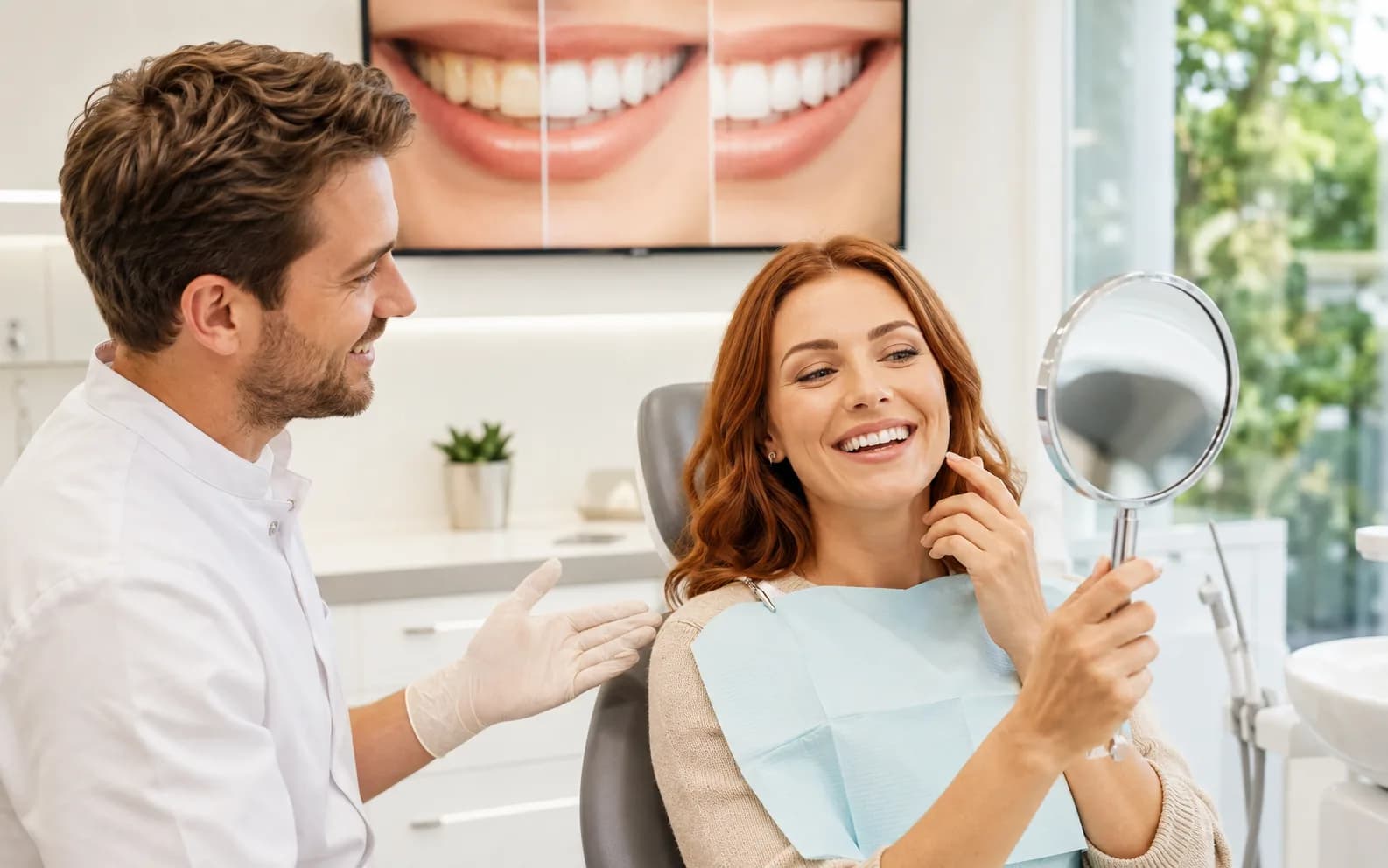
- Average duration
- 45 minutes
- Sessions
- Klinikte 1-2 seans · evde 7-14 gün
- Clinic
- Cosmetic Dentistry
How whitening works
The active agent in whitening gels is hydrogen peroxide or carbamide peroxide. It chemically breaks down the coloured molecules within enamel and dentine. Enamel is not abraded or removed; the change happens inside the structure.
Whitening does not work on every kind of discolouration. It is effective for staining from tea, coffee and smoking and for age-related yellowing. For tetracycline staining, fluorosis and single dark teeth after trauma, the result is limited or a different approach is needed.
Examination first
Before whitening, decay is treated, calculus removed and gum health assessed. There are two reasons: gel can pass through an open cavity and reach the nerve, and scaling alone already reveals the true colour of the teeth. In some patients whitening becomes unnecessary after a clean — saying so is part of the treatment.
Existing fillings and crowns do not whiten. If there are restorations on the front teeth, a colour mismatch will appear after whitening and they may need replacing. This is always discussed beforehand.
Methods
In-clinic whitening
A high-concentration gel is applied after the gums are protected with a barrier. The session lasts 45 to 60 minutes; one or two sessions are usually enough.
Take-home whitening
A low-concentration gel is placed in custom-made clear trays and worn for a few hours a day or overnight, over 7 to 14 days. It is slower but more controlled, with less sensitivity.
The two can also be planned together.
Sensitivity
Cold sensitivity during whitening and for 24 to 48 hours afterwards is common and temporary. Gels containing potassium nitrate or fluoride reduce it. If sensitivity is marked, treatment is paused; there is no need to push through.
How long it lasts
The result is not permanent. Staining foods and drinks (coffee, tea, red wine, tobacco) and time gradually bring the shade back. A top-up every one to two years may be needed; keeping your take-home trays makes that straightforward.
Whitening is not performed during pregnancy or breastfeeding, under the age of 18, or in people allergic to peroxide.
This page is general information and does not replace a dental examination. Whether the treatment suits you, and the method and duration, are decided only after an intraoral examination and radiographic assessment.
After treatment
- Avoid coffee, tea, cola, red wine and dark foods for the first 48 hours.
- Do not smoke for the first 48 hours.
- Use the desensitising toothpaste advised if you feel cold sensitivity.
- Keep take-home trays clean and dry; never rinse them in hot water.
- If you have restorations on front teeth, we will review the colour match at your check-up.
- Plan a review after 12 to 24 months for a top-up.
Frequently asked about this treatment
No. Whitening gel does not abrade enamel; it chemically breaks down the coloured molecules within enamel and dentine. Performed under dental supervision, at the appropriate concentration and with the gums protected, no structural damage to enamel is expected. Temporary cold sensitivity is usual and passes within a few days.
On average one to two years; an exact figure is not possible because the result is directly tied to diet and habits. Coffee, tea, red wine and tobacco speed the return of colour. If you keep your take-home trays, a top-up can be done with a short application.
The information on this page is for general guidance and does not replace a dental examination. Treatment decisions are made after an intraoral examination and radiographic assessment.
Related treatments
Examination first, decisions after
Book an appointment: we will assess where things stand and talk through the options and how long each takes.
Your request is confirmed the same day.